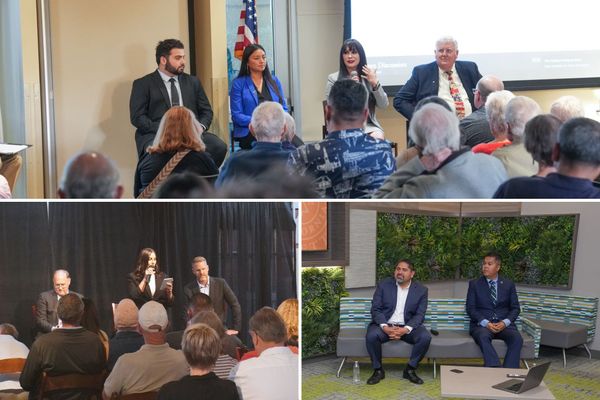
Candidates running for City Council seats in Wards 2, 4 and 6 found rare common ground at Raincross Gazette-hosted forums last month: Riverside has too many warehouses and not enough good jobs. But agreement largely ended there, with candidates offering competing visions for what kinds of industries the city should pursue — and how much risk it should take to get them.
Moderator Dan Bernstein, a former Press-Enterprise columnist and longtime Riversider, posed the same question to candidates at all three forums:
There probably isn't a single candidate in these City Council races who doesn't want to bring good jobs and better businesses to Riverside. What kinds of jobs and businesses does the city, especially your ward, need the most? And what does a council member actually do to attract these jobs and businesses?
Ward 2
Nonprofit director and Budget Commissioner Aram Ayra, entrepreneur and Planning Commissioner Christen Montero, Western Municipal Water District Director Gracie Torres and financial and IT consultant Mike Vahl are running for the Ward 2 seat soon to be vacated by Councilmember Clarissa Cervantes, who is running for state Assembly.
Ward 2 covers neighborhoods including Eastside, Canyon Crest, Mission Grove, Sycamore Canyon and the University District.
Torres: "This is my number one passion. So I have a sweet 18-year-old who is facing down this job market. So that is one of the reasons that's such a high priority for me. And it's not just for students graduating college or graduating high school, it's also for mothers that want to enter the workforce again after having stayed at home for 18 years.
And these are opportunities that we need. And I've done it. I brought $2 million into the region to create good-paying careers, not just jobs, careers in the water and wastewater industry.
What we're seeing is that about 30% of our workforce was about to retire. And so we said, how do we address this, but in an equitable way? And so we partnered with community-based organizations to recruit from communities that haven't had access to these careers before.
We've trained them and certified them and then placed them in jobs in the water industry.
I want to do the same thing in the city. And I don't know if a lot of you know this, but to work in the city or the county, you actually need a bachelor's degree.
A bachelor's degree when I was when I was finishing college, meant a lot, and that's just not the case anymore.
There is no reason why these entry-level jobs cannot be more accessible to our residents.
I was just talking to my friend here and telling him, I worked for the county for 12 years, and I'm never leaving. I have a career. I'm never leaving. I love it. That's a good-paying union job. But that's because I work 10 minutes away.
I cannot fathom having to drive to another city, and those are the opportunities we need to create. Not only is it good to build economic development, but it's also a great way to start alleviating the traffic that we have here in the city. When people work in their city and play in their city and retire in their city, we're alleviating at a certain percentage, how much is coming in and out, when it comes to traffic."
Montero: "Yeah, I would say having having more jobs in the city [and] county is good – but we also need to see more jobs in the private sector, because right now, there's a lot of companies that want to pay hourly and not salary, and then when they want to pay salary, they don't want to provide benefits.
How could any of our younger generation ever be able to afford a home, let alone for us to have forward economic development within our community that continues?
Secondly, when it comes to people and not getting the salaries, we also got to look at what types of industries we're letting come in right now.
We have a lot of warehouses come in because we said create a lot of jobs, but my younger brothers, they went in and there was no forward movement.
There was no career to be held. The hourly looked great to trap them, but in the end, they slowly quit and found something else.
And now a lot of our folks are taking jobs in LA, Orange County, where they're willing to pay. We don't want to lose that in our community.
So I think it's important to have a supporting student pipeline for a younger generation, whether they go to RCC, whether they go to CBU, and also helping our local small business owners to have access to resources like that as well, and that way those small business owners can also provide forward paying jobs that provide upward momentum and opportunity and maybe even gets them ready for their next big job, right?
So I know we have our innovation hub that just got created, or our district that got deemed without a lot of our resident consent, usually it gets consented and discussed and then deemed and rezoned as an innovation district, but that did not happen for us."
At this point, Bernstein asked a follow-up question to Ward 2 candidates:
Let me redirect a little bit in terms of looking down the road. I see you were saying that next five to 10 years out, what kind of jobs are you specifically looking at?
Montero: "I would say clean tech companies right now, in general, [and] agriculture is a huge part of Riverside. I think we need to continue to have a focus on that as well, and innovation. We can't become stagnant and have companies coming in that aren't open to new ideas and sticking to the traditional, we don't want what happened with Kodak and Fujifilm to happen in our entire city, because we lack the openness to innovation."
Vahl: "One of the things that we don't need to do is fly people to the Far East and become investment bankers. We find a company that's a startup that's never done anything, offer them a couple million dollars to come to our city and open an office and develop their product, and maybe in five or 10 years, they'll have something they may be able to sell.
I don't think anybody – our mayor or our city council – are tech entrepreneur or venture capital people, so if they have the expertise to do that, they're just looking for a deal to bring back, to say, hey, we brought back a job or a company and they're going to create all this stuff…"
Montero: "Mike, does that mean you're against entrepreneurship?"
Vahl: "That's not what I said, I said I'm going over, finding overseas companies and becoming a venture capital firm for them."
Ayra: "I agree with Mike, the city has prioritized big business at a loss for our small business community. And I'm out talking to a lot of our small business owners, and they feel squeezed on all sides.
You know, post Covid, especially, has been difficult, but the city charges really high in utility rates. They charge them really high fees and permits. They make it difficult.
You know, I love the chamber, but I know a lot of small businesses have said that the focus of the chamber is on big business. I get that, we need the development in the city too, but what kind of big businesses are we bringing into Riverside?
Because right now, our focus has been on logistics and warehousing, and those are not the type of jobs we need for the future. Are they bad jobs? No, I don't see anything as a bad job. I worked at a warehouse for two summers to pay my way through UCR.
But are there better jobs that we're totally missing and not bringing in? Absolutely.
My priority would be healthcare jobs –those are relatively future proof jobs.
My priority would be advanced manufacturing, trying to put as many of our warehouses into advanced manufacturing as possible – and most importantly, support for our small business community.
There's been so many incredible small businesses in Ward two, but across the city, that have felt neglect from the city, that have felt that their costs are too high and have felt that Riverside is not a place for them, and that's unacceptable to me. Small businesses constitute the bulk of our job creators in this city, or at least a very solid bulk of our job creators."
Vahl: "Small businesses are getting neglected. Like I said, with planning small businesses is same way. One of the guys in Ward two told me – he opened a deli – put in a permit a couple months later to get a grill. Took them a year. Then that started working out. We asked for pizza oven, that took 18 months. That's two and a half years for that something should have taken a week. And it's ridiculous. We shouldn't do that to our small businesses."
Torres: "I agree completely. But again, we can't just make promises rather than present actual, tangible plans.
And again, I've done this at Western. We created an incentive program for businesses that became water resilient. We helped them out with their turf. We gave them deals on their utilities. The city can do the same thing. We not only need to incentivize businesses to join the city, we need to reward those that have stayed in the city.
And by doing that, we create more jobs and those who hire locally, also should receive an incentive so that they can continue to do so."
Ward 4
Incumbent Chuck Conder, local business owner Jessica Qattawi and local business owner Rich Vandenberg are vying for the Ward 4 council seat.
Ward 4 covers neighborhoods including Alessandro Heights, Mission Grove, Orangecrest and the Greenbelt, which became a part of Ward 4 during redistricting in 2023 – meaning many residents in this area will be voting in a Ward 4 race for the first time this year.
Vandenberg: "I can tell you what we don't need. We don't need logistics warehousing. We have enough. We're too dependent on logistics warehousing. We're in a new era. We're in the era of AI, automation and robots. When that happens, these are gonna be the first jobs to go.
We're too dependent on 'em. Our economy [will be] in trouble if we don't shift gears quickly.
I would focus on healthcare jobs, advanced manufacturing and tech jobs. We have 70,000 students among our four colleges. Two most common degrees are Business Administration and healthcare. We have companies in Orange County, San Diego County and LA County looking to expand. We're doing an okay job, I guess, going overseas, attracting new tech companies. I wouldn't bank on these. These are gambles. We're investing them and hope they turn out, and I hope they do, but that's no sure thing, and not something I'm willing to bank Riverside's economy on. I'm going to recruit companies from LA, Orange and San Diego County that want to expand. We've got cheaper land, we've got utilities, we've got a workforce pipeline, they're right here in Riverside, they want to stay here. They're being forced out because of lack of work."
Conder: "So the way you attract business is you go meet the business people. You don't know what ICSC is, it's the large gathering up in Las Vegas for all of the companies who want to do business around the nation.
I've brought two companies here by going there, and I'll say how funny it was – I've sat down with two or three different ones over the years and the first thing they [do is] look at me and say 'what are you doing here?...we've never had an elected sit with us.' That's why I go to ICSC. I brought two businesses here so far. The one for Ward four you've seen is EOS up in the image and growth shopping center.
We have $4.8 billion – that's a B with a billion folks – of investment coming into Riverside. They're investing in us, Mr. Vandenberg, we're not investing in them. They're investing in us. I was Hyundai, I wrote them yesterday, where they're building the motors and the equipment for the electric trains that will be serving part of the Olympics in Los Angeles. We've got Chaevi coming in here, the world leader of battery technology. We've got $4.8 billion, and gonna put a billion dollars in the community hospital. It's coming, it's here… We lost –hear this now – we lost a Fortune 50 company up on the plateau and we lost another manufacturing company that was manufacturing medical devices. That was shortsightedness…we lost maybe upwards of a thousand high-paying jobs up there. We need to bring in industry here and ward 4 has very very little land left to do…the [plateau was county]...because of what happened Riverside has no say anymore about what will happen on that land, it's out of our control, it's now in the control of the five Board of Supervisors' members. We have very little land in ward 4, we can try to [bring] small businesses in here, but there's no place to build large businesses in ward 4."
Qattawi: "Let's talk about Ohmio. Have you guys heard of Ohmio? It's right by the riverside airport. So the city paid them $2 million to come here and set up a facility. They said they were going to bring jobs, and they were going to do all these great things for our city, and guess what? Two years later, nothing.
I have not even seen one of their electric shuttles out on the road. We need to stop wasting money. I can't wait for the inspector general position to start.
But no warehouses, definitely no warehouses. We don't need any more warehouses. We have 16 million empty square feet of warehouses in Riverside right now.
What we need is white-collar jobs. We need people that are going to be able to afford to live, rent, buy food and take care of their families.
So I have an idea, and I'm an innovator. I was actually the first social media marketing company here in the Inland Empire. So I saw an opportunity, and I jumped on it. I turned $1,000 into millions of dollars. So I'm a smart business woman, but I'm also a humanitarian.
And so I want to tell you guys this idea that I have for the empty warehouse space. So I want to really help generate more business owners through our community. And so what I would like to do is [take] that empty warehouse space that we have [and] actually break it up into smaller mini warehouses and start giving people opportunities to start their own businesses within these spaces. So rather than them sitting there and being empty, we could do something like that that will start generating more money for the city as well. But that's just an idea but we definitely need to make sure that we're taking care of our community."
Conder: "If you'd come to the Ohmio event last month, you could have ridden in one of the machines. They're not building them for Riverside, they're building them for the world. Riverside is looking at how we might be able to use them, but the jobs are there. The people are having jobs. They're building them. You're not going to see them in the city until we do a full analysis of how they're going to be used. They are autonomous. And the problem sometimes with autonomous vehicles – if you look at the ones that you can do the cab ride now – sometimes they've had accidents with those things. But the jobs are here. They're being built, they're just being sent around the world, right now they're at JFK airport in New York, so they're here and they're making money for us."
Vandenberg: "Just to correct you, did we not make an investment for them to come here? Yes or no? Because I'm certain we did and you just said they invested in us – well, they did by coming, but we invested in them to get them here, that's why we attracted them."
Conder: "Did we help them come here, yeah. It's called return on investment, long-term. You get the jobs, the people here, those people live in Riverside, they're spending money in Riverside, it's called ROI."
Ward 6
Oz Puerta, executive director of the Arlington Business Partnership, Luis Hernandez, vice chair of the Board of Ethics, and Alvord Unified School District Board of Education Trustee Norma Berrellez are vying for the seat vacated by Councilmember Jim Perry, who announced last year that he is not running for reelection.
Berrellez, however, was not in attendance at the April 30 Ward 6 forum.
Ward 6 covers neighborhoods including Arlanza, La Sierra, La Sierra Hills, La Sierra South and portions of Arlington.
Hernandez: "When it comes to attracting jobs for the city and our ward overall, it's important to look at the trends and what's going on nationally and locally. There was a point in time in history where warehouses meant jobs. That's not true anymore.
The reality is that artificial intelligence and automation are taking over a lot of jobs and it's going to be difficult for anybody in office to determine what the future holds, but we can look at reliable sources when it comes to what helps keep most people employed. And usually that's in the industries of technology and the medical field.
Looking forward to the future, it's environmental jobs that have to do with producing technology and revolving around the environment and how to improve our situation when it comes to overall quality of life.
We have a lot of individuals who are senior citizens, who are getting older. Obviously instead of being on the streets, there are facilities where they can be taken care of. So there's a lot of different opportunities that we can look into to make sure that our residents have good-paying opportunities.
Obviously partnering with unions and trying to create apprenticeship programs where you don't have to have a college degree to find a good job, at least a decent paying job ... You don't have to own a few homes, but you know, you can at least survive, pay for food, and have a vehicle. Those things shouldn't be out of reach for anyone who works.
And it's disappointing to hear someone blame the victims when it comes to unaffordability and how difficult it is. If everyone wanted to be the CEO of a company, there wouldn't be any. There's all kinds of people who provide services and without those individuals, you wouldn't get your food at a fast food joint, at a local restaurant. Wherever it is, people work hard and they deserve to be able to at least have a place to live, food on the table and be able to pay their bills."
Puerta: "So on the topic of jobs, I just mentioned the Riverside Auto Center told us that they were struggling to hire technicians at $70 an hour. Right now what I'm doing is I'm meeting with the skilled trades to try to see where those opportunities are. I'm meeting with other city departments. We found out that there's an EMS program in Chula Vista and Anaheim where the cities took it upon themselves to fill in their in-house needs on EMS services and provided a pathway to careers for high school students. That's a great thing.
Jim Perry has focused a lot of his time and focused on career and technical education. We need more of that. Right now, we need a lot more people to fill in the skilled trades position. We also need to grow on what's recession proof. Healthcare is recession proof. We need more of it. Kaiser is expanding, they're adding more beds and hopefully we'll have some new housing projects that can accommodate the new staffing that's going to be there so people can live local, work local, stay local.
As far as the way a council member can do is we can facilitate things like apprenticeship programs through the chamber, through the universities.
I know that again, bringing up the auto center, they're trying to work with one of the universities to bring in a work experience and internship program so they can meet those needs, the hiring needs. We just need to work with the groups around us, with the big players and figure out what jobs they can't fill, and educate our students to understand that those pathways are available."